
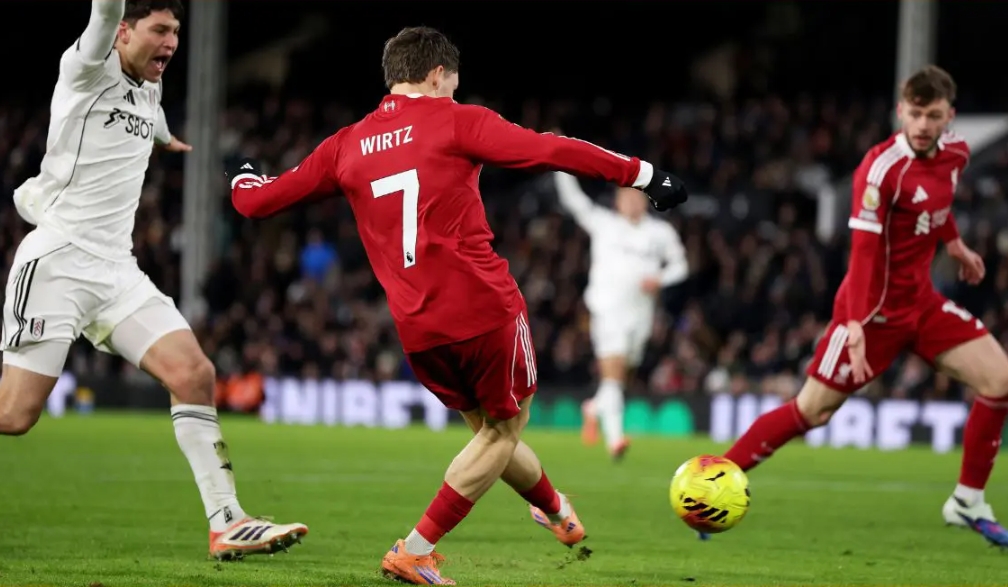
Liverpool’s latest Premier League draw has been analysed from every possible angle, yet one incident continues to dominate the conversation well beyond the final whistle.
Florian Wirtz’s equaliser at Craven Cottage looked marginal in real time, prompted an extended VAR review, and was ultimately given despite claims that the German attacker had strayed offside.
BBC Sport football correspondent Dale Johnson has since clarified why the goal was allowed, even though the Bayer Leverkusen signing was technically just beyond the defensive line.
“Wirtz appeared offside — and in truth, he was, by a tiny margin,” Johnson explained. “So why did VAR still allow the goal to stand?”
The answer lies in the Premier League’s continued use of an offside margin of error, even with semi-automated offside technology now in operation.
BBC explain why Wirtz goal passed VAR
The BBC reports that the league still applies a tolerance threshold to account for technological limitations, such as pinpointing the exact frame in which the ball is played.
As a result, a player can appear fractionally offside on the freeze-frame but still be judged onside once that buffer is applied.
Johnson noted that when this system was first introduced in 2021/22, officials estimated it could lead to “around 20 extra goals per season.”
That background is relevant because Wirtz’s strike came during Liverpool’s best spell of the match, which was sparked by Conor Bradley’s driving run through Fulham’s midfield.
The 22-year-old finished calmly, and the underlying data supports his influence despite being on the pitch for only 76 minutes.
That impact fits with his recent form, with Wirtz now posting two goals and one assist across his last four starts.
Slot’s comments on Wirtz and Liverpool’s approach
“For the first time without a winter break, for the first time at Champions League intensity.”
Those remarks give further context to Slot’s earlier comments after the Leeds match, when he spoke about the need to manage key attackers carefully during a relentless run of fixtures with little opportunity for rotation.
They also reflect reports before kick-off that Liverpool were keen to avoid risking a longer layoff for Ekitike and instead hoped his absence would be short.
How Ekitike’s absence affected Liverpool at Fulham
Without a natural No.9, Liverpool dominated possession in the first half but lacked cutting edge, reinforcing concerns that teams are increasingly comfortable sitting deep against them.
Wirtz’s equaliser after the break lifted the tempo, but even then the attacking structure felt patched together rather than smooth and cohesive.
Slot also confirmed that Wirtz has been dealing with similar physical demands, revealing that the German recently underwent an MRI scan which showed only fatigue-related soreness.
“If I had more options, I’d rotate more,” Slot admitted. “But with the players I have, I try to use them as much as I realistically can.”
That pragmatic approach may test the patience of supporters in the short term, but it reflects a longer-term strategy as Liverpool juggle domestic and European ambitions.
With Arsenal up next, Liverpool will be hoping Ekitike’s absence is brief — and not an early sign of wider strain beginning to surface in the squad.
